


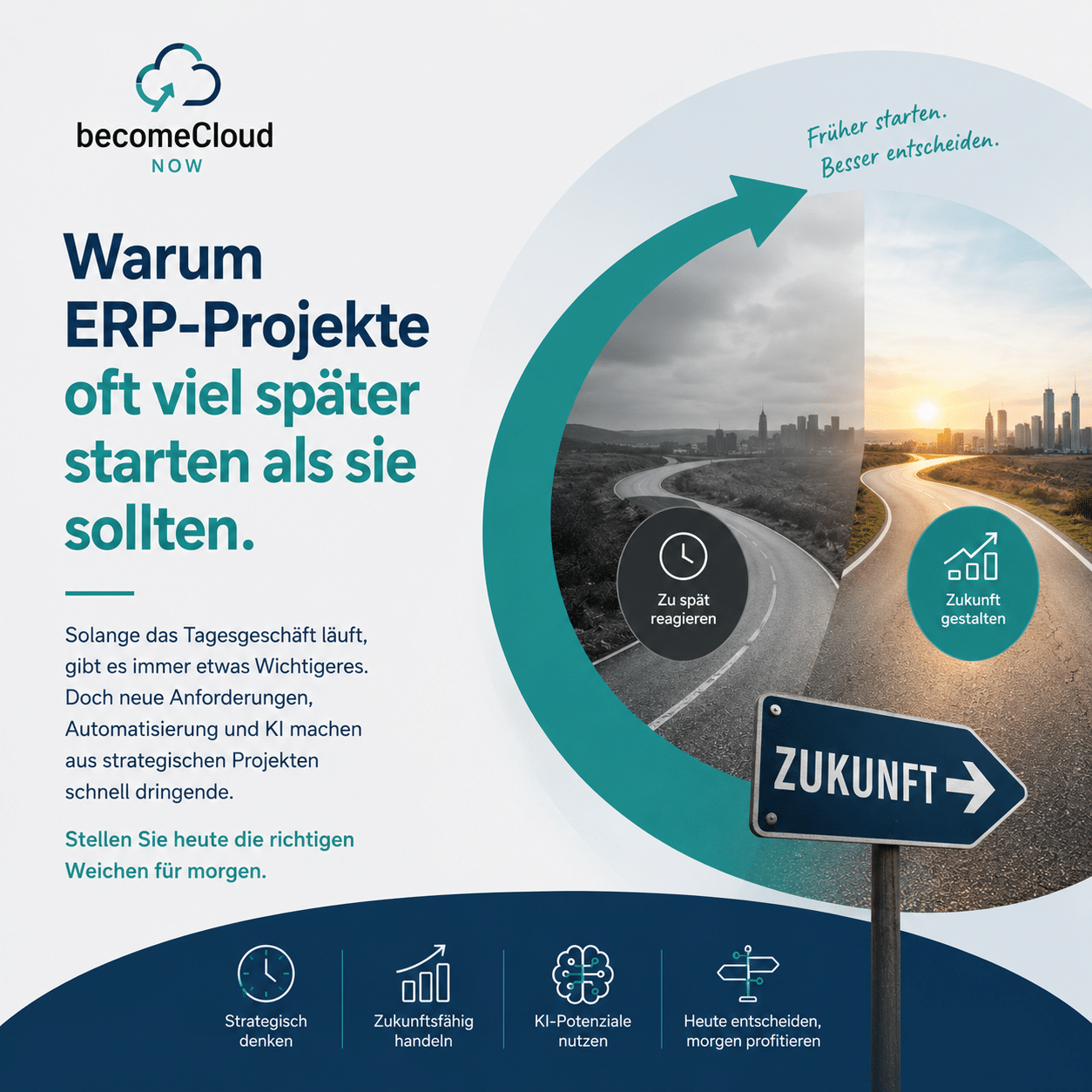
A few weeks ago, we had a conversation with a prospective client about process optimization using AI. At first, it was a completely separate topic.
At some point, the following statement came up:
“Actually, we’ve known for quite some time that we’ll eventually have to replace our ERP system to ensure the future of our processes and our company.”
What we took away from this:
It’s almost never a lack of awareness.
It’s almost always the right timing that’s missing.
Because as long as day-to-day operations are running smoothly, customers are satisfied, and the monthly closings are somehow working out, there are supposedly more important issues to address.
The problem often doesn’t become apparent until later.
That is, when new requirements arise.
When processes need to be automated more extensively.
When AI capabilities need to be leveraged.
Or when analytics and transparency suddenly become significantly more important than they were just a few years ago.
That’s when the pressure builds.
And a strategic project turns into an urgent one.
Our experience from many cloud ERP projects:
The most successful companies don’t start by selecting software.
They start with the question:
“Where do we want to be as a company in three to five years—and does our current system landscape still support that goal?”
ERP projects rarely start too early.
But surprisingly often, they start too late.
