


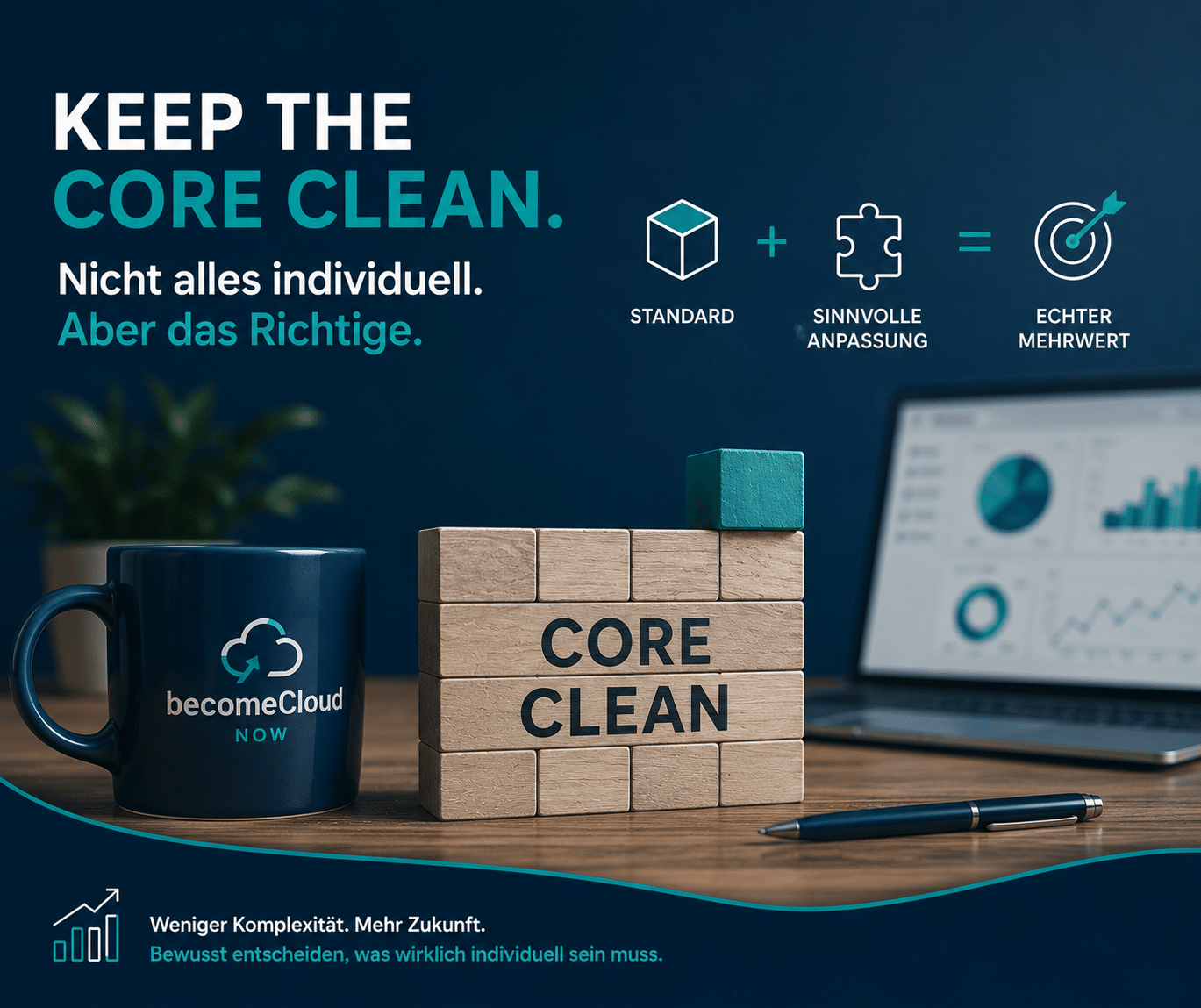
It’s rare for customers to say, after their ERP go-live, that they wish they had customized their system more or had additional features programmed.
The reality often becomes apparent later: over the years, more and more custom solutions are added. A small adjustment here, an additional report there, or a custom process for a special case.
“But the business absolutely needs this button right now.”
Every single decision is understandable.
Together, however, they often result in a system that becomes increasingly complex—in terms of maintenance, enhancements, and sometimes even day-to-day operations.
That’s exactly why our perspective on ERP projects has changed.
Not every requirement should be implemented individually.
Sometimes it’s more worthwhile to question your own process.
After all, standardization doesn’t mean sacrificing flexibility.
It lays the foundation for being able to use new features, automation, and AI much more easily in the future.
Perhaps that’s the real challenge of modern ERP projects:
Not making everything technically possible.
Rather, it’s about consciously deciding what truly needs to be customized.
And let’s be clear: of course, we also develop custom extensions for our clients—but only where they make sense in the long term and are release-safe.
After all, not every requirement belongs in the standard system.
But neither should every requirement change it.
